
Your Cart is Empty
Free domestic shipping | Complimentary ring Re-sizing | Flexible Layaway Available
Free domestic shipping | Complimentary ring Re-sizing | Flexible Layaway Available
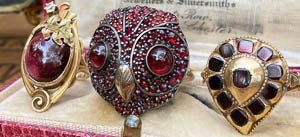
For millennia, no gemstone has commanded quite the reverence of the ruby. Ancient Sanskrit texts called it ratnaraj—"king of precious stones"—while medieval Europeans believed rubies held the power to preserve health, wealth, and wisdom. Burmese warriors even embedded them beneath their skin before battle, convinced the stones would grant invincibility. This mystique wasn't merely superstition: rubies are rarer than diamonds in nature, and the finest specimens—with their coveted "pigeon's blood" red—have fetched higher prices per carat than any other colored gemstone.
Antique and vintage ruby jewelry carries this extraordinary legacy forward, each piece a tangible link to eras when master jewelers set these crimson treasures by hand. From the romantic cannetille work of the Georgian period to the bold geometry of Art Deco, these jewels tell stories of passion, power, and artistry that transcend time. The warm glow of an antique ruby—softened by age, set in buttery old gold or delicate platinum—possesses a romance that modern pieces rarely capture.
Join us as we explore the fascinating history of rubies through the ages, the exceptional craftsmanship that defines antique jewelry, and the remarkable pieces that grace our collection today.

Rubies have mesmerized humanity since ancient times. Hindu texts described them as the most precious of the twelve gemstones created by God, calling them Ratnanayaka—lord of gemstones. Medieval physicians prescribed powdered ruby as a cure for liver ailments and heart troubles, while Chinese noblemen laid rubies along the foundations of buildings to secure good fortune. The Mogul emperors of India so prized exceptional rubies that they often valued them above diamonds of equal size, inscribing them with prayers and wearing them as talismans.
By the Victorian era (1837-1901), rubies had become the ultimate symbol of romantic love. Queen Victoria herself cherished rubies, and her influence sparked a fashion for ruby engagement rings, lockets, and brooches—often featuring snake motifs (representing eternal love) or hearts. Jewelers set these crimson gems in rich yellow gold, sometimes surrounding them with seed pearls or black enamel for dramatic mourning pieces.
The Edwardian period (1901-1910) brought a lighter touch. Platinum's newfound malleability allowed jewelers to create airy garland designs and knife-edge settings, with rubies nestled among delicate millegrain work and diamond tracery—feminine confections that seemed to float on the skin.
Then came the roaring twenties and Art Deco (1920s-1930s), when everything changed. Rubies took center stage in bold, geometric designs: calibré-cut stones formed striking linear patterns in bracelets and brooches, often contrasted with onyx, jade, or brilliant-cut diamonds. These weren't your grandmother's romantic jewels—they were statements of modern sophistication and independence.
Through every era, one truth remained constant: the ruby has always represented passion, power, and prestige—cementing its place as the crown jewel of vintage and antique jewelry design.

Not all rubies are created equal. The most prized specimens display the legendary "pigeon's blood" color—a term coined by Burmese gem traders to describe an intensely saturated, pure red with subtle blue undertones and an almost fluorescent glow. This phenomenon occurs due to trace amounts of chromium within the corundum crystal structure, the same element that gives rubies their red color and causes them to fluoresce under ultraviolet light, appearing even more vivid in sunlight.
Rubies rank 9 on the Mohs hardness scale—second only to diamonds—making them remarkably durable for daily wear. Yet their true rarity surpasses that of diamonds: fine natural rubies over two carats are exponentially scarcer than comparable diamonds, and those over five carats with exceptional color and clarity are museum-worthy treasures.
The rubies found in antique jewelry carry an added distinction. Before modern precision cutting became standard in the mid-20th century, lapidaries hand-cut each stone individually, carefully studying the rough crystal to maximize its color and character rather than following standardized proportions. The result? Antique ruby rings and pendants often feature old mine cuts, cushion cuts, or mixed cuts—each with slightly irregular facets that create a warm, candlelit sparkle distinctly different from modern brilliant cuts. These stones seem to glow rather than glitter, their light dancing softly beneath the surface.
Antique rubies also tend to be unheated and untreated—qualities increasingly rare in today's market, where over 95% of rubies undergo heat treatment to enhance their color. Many Georgian and Victorian-era rubies display charming "silk" (fine rutile needle inclusions) visible under magnification, evidence of their natural state and a fingerprint of authenticity prized by collectors.

Vintage Natural Burmese Ruby and Diamond Cluster Ring
A radiant certified Burmese ruby takes center stage in this exquisite cluster ring, framed by sparkling diamonds and set in lustrous gold. The vivid hue and timeless design make it a true heirloom-quality piece.
Victorian Natural Ruby and Diamond Pendant (c.1890)
This romantic pendant features natural rubies and glittering diamonds set in rich 14k gold. Its delicate proportions and warm palette capture the charm of late 19th-century craftsmanship.
Antique Ruby and Diamond Floral Bracelet
Lush ruby blossoms bloom across this dazzling bracelet, accented by twinkling diamonds and set in ornate gold. The floral motif evokes the naturalistic elegance of 19th-century design.
Antique Ruby, Diamond, and Pearl Bracelet
A luxurious statement piece showcasing luminous pearls, vivid rubies, and glittering diamonds. Its refined design reflects the artistry and enduring beauty of antique jewelry.
Each jewel in our collection embodies history, beauty, and the unmistakable allure of fine rubies—stones that continue to inspire passion across generations.
→ View our full Ruby Jewelry Collection

While rubies themselves are remarkably durable, the settings that hold them—particularly those from the Georgian, Victorian, and Edwardian eras—require thoughtful care. Antique metalwork, delicate filigree, and original patinas are irreplaceable, and preservation should always be the priority.
Gentle Cleaning at Home For routine maintenance, use lukewarm water, a few drops of mild dish soap, and a soft-bristled brush (a baby toothbrush works perfectly). Gently clean around the stone and setting, then rinse thoroughly and pat dry with a lint-free cloth. Never soak pieces with closed-back settings, as trapped moisture can damage the foil backing or cause tarnishing you can't see.
What to Avoid Skip ultrasonic cleaners entirely—the vibrations can loosen stones from antique settings or crack rubies with significant inclusions. Similarly, avoid steam cleaners, harsh chemicals, chlorine bleach, and commercial jewelry dips, which can damage old gold alloys, erode delicate metalwork, or strip away desirable patina.
Smart Wearing Habits Remove your ruby jewelry before swimming, showering, exercising, or applying lotions and perfumes (which can build up around settings). While rubies can handle daily wear, antique pieces with high-set stones or ornate details are best reserved for occasions where they won't catch on clothing or encounter rough surfaces.
Professional Care Have your antique ruby jewelry professionally inspected annually by a jeweler experienced with period pieces. They can check prong security, identify loose stones before they're lost, and provide expert cleaning that respects the piece's age and construction. A knowledgeable specialist won't "brighten" or over-polish antique gold, which would erase the warm patina that's part of its charm.
Storage Matters Store each piece separately in a soft cloth pouch or lined jewelry box compartment. Even though rubies are hard, metal settings can scratch each other, and chains can tangle around delicate filigree.
With proper care, your antique ruby jewelry will continue to radiate the same beauty that captivated its original owner—a luminous legacy to treasure for generations to come.

For thousands of years, rubies have held humanity in thrall—not merely for their breathtaking beauty, but for everything they represent. These crimson treasures have witnessed empires rise and fall, adorned the hands of queens and empresses, and sealed countless promises of eternal love. The "king of gemstones" has never abdicated its throne.
When you hold a piece of antique ruby jewelry, you're not simply admiring a beautiful object—you're connecting with this profound legacy. That Victorian ruby ring once symbolized a romance in gaslit parlors. That Edwardian pendant caught the light at garden parties over a century ago. That Art Deco bracelet embodied the bold spirit of a new modern age. Each piece is a time capsule, preserving not just exceptional gemstones and masterful craftsmanship, but the passions and dreams of those who wore them.
In an era of mass production and synthetic perfection, antique rubies offer something increasingly rare: authenticity, individuality, and soul. These are jewels with stories to tell and stories still to be written.
Ready to discover your own piece of ruby history? Explore our carefully curated collection of antique and vintage ruby jewelry—each treasure personally selected for its exceptional quality, historical significance, and that indefinable magic only genuine antique jewels possess. Whether you're drawn to romantic Victorian sentimentality, Edwardian elegance, or Art Deco glamour, there's a ruby waiting to captivate you.
After all, some love affairs are timeless.
→ View our full Ruby Jewelry Collection