
Your Cart is Empty
Free domestic shipping | Complimentary ring Re-sizing | Flexible Layaway Available
Free domestic shipping | Complimentary ring Re-sizing | Flexible Layaway Available
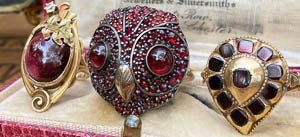

There's something haunting about holding a piece of Victorian jewelry in your palm. Perhaps it's a jet mourning brooch, its carved flowers still sharp after 150 years. Maybe it's a ring with gemstones spelling out DEAREST, a secret love letter worn openly on someone's finger. Or a locket containing a coiled braid of chestnut hair from someone who died when Lincoln was president. These pieces are more than beautiful objects—they're portals to other lives, other loves, other griefs.
Victorian jewelry, created during Queen Victoria's reign from 1837 to 1901, emerged from a world we can barely imagine. It was an era when average life expectancy hovered around 40 years, when cities reeked of horse manure and open sewers, when women couldn't be alone with their suitors, and when death was so ever-present that people wore elaborate jewelry to mark their grief. Yet it was also a time of explosive innovation, when the Industrial Revolution made beauty accessible to people who'd never owned fine jewelry before, when archaeological discoveries sparked imaginations, when new gemstones arrived from distant mines, and when craftspeople achieved technical brilliance that still astonishes us.
To understand Victorian jewelry is to understand the people who wore it—and they were us, really, just navigating different constraints and possibilities. They loved as fiercely as we do. They grieved as deeply. They wanted beauty, meaning, and connection. The difference is that they poured all of this into objects they could wear against their skin, creating a material culture of emotion that we're still drawn to more than a century later.
Imagine you've fallen in love, but you cannot say so. Not directly, anyway. Your society forbids such forward declarations. You can't text, can't email, can barely be alone together. Your letters are read by chaperones. Public affection would ruin your reputation. So how do you tell someone your heart is theirs?
The Victorians, constrained by elaborate codes of propriety, became masters of secret languages. Their jewelry whispered what their lips could not say, using symbols, flowers, and even the first letters of gemstones to communicate forbidden feelings. These hidden messages weren't just clever—they were essential, one of the few sanctioned ways to express genuine emotion in a world that demanded restraint.

The genius of acrostic jewelry lies in its beautiful deception. To anyone glancing at your ring, it's simply a lovely arrangement of colored gemstones—a diamond, followed by an emerald, then an amethyst, a ruby, another emerald, a sapphire, and finally a topaz. Pretty, certainly, but unremarkable. Only you and the person who gave it to you knew that this innocent-looking ring is actually a declaration of devotion hiding in plain sight.
This form of coded jewelry flourished during the Victorian era, though its roots stretch back to Georgian times. The concept was elegantly simple: use the first letter of each gemstone's name to spell words of affection or sentiment. Diamond, Emerald, Amethyst, Ruby, Emerald, Sapphire, Topaz became DEAREST—the most popular acrostic message. Ruby, Emerald, Garnet, Amethyst, Ruby, Diamond spelled REGARD, often given in early courtship or between friends. The less common but intensely personal ADORE used Amethyst, Diamond, Opal, Ruby, and Emerald.
The secret itself carried romance. When a young woman wore her DEAREST ring, she and her suitor shared knowledge that no one else possessed. They could look at each other across a crowded drawing room, and she could glance at her ring, and he would know she was thinking of him. The Victorian social constraint that made such coded communication necessary actually heightened the intimacy—the jewelry created an exclusive world of two.
Acrostic pieces appeared most commonly as rings, but you'll also find brooches, bracelets, and pendants spelling out their secret messages. The gemstones used were typically genuine, though their quality varied with the giver's means. A wealthy suitor might present a DEAREST ring with fine-quality stones in substantial sizes, while a clerk might give smaller stones or use less expensive alternatives like garnet substituting for ruby. What mattered wasn't the monetary value but the message—and the thoughtfulness of choosing stones to spell something meaningful.
Today, authentic Victorian acrostic jewelry commands serious attention from collectors. A genuine DEAREST ring in good condition with natural gemstones and period-appropriate gold work can range from several hundred to several thousand dollars, depending on the quality of stones and craftsmanship. The word DEAREST tends to be most valuable because it was most popular and most clearly romantic. Other acrostic words, being less common, can be more affordable entry points for collectors interested in this intimate form of Victorian communication.

If acrostic jewelry spoke through gemstones, floriography—the language of flowers—allowed Victorians to communicate through blooms. This wasn't a vague symbolism where flowers generally meant pretty things. No, this was a detailed vocabulary where every flower carried specific meaning, where the difference between a red rose and a yellow rose was the difference between "I love you" and "I cherish our friendship."
The obsession with flower language reached Victorian England through Lady Mary Wortley Montagu, who wrote in the early 1700s about the Turkish "selam"—a system of communication using flowers and objects. By Victoria's reign, floriography had become a cultural phenomenon. Multiple dictionaries of flower meanings circulated, and while they didn't always agree on every detail, certain flowers had universal significance. Forget-me-nots meant true love and remembrance. Pansies conveyed "you occupy my thoughts"—the name itself comes from the French "pensée," meaning thought. Ivy represented fidelity and marriage. Roses spoke of love, though their color mattered: red for passionate love, white for innocence, yellow for friendship.
For women whose formal education was limited, learning flower meanings provided intellectual engagement that society deemed appropriately feminine. You could study botanical details, memorize symbolic associations, create bouquets that told stories—all within the bounds of proper behavior. This made floriography socially acceptable while allowing for genuine complexity and creativity.

Victorian jewelers translated these floral messages into wearable art. They painted forget-me-nots in delicate blue enamel on gold lockets. They carved pansies from coral and shell. They created brooches featuring entire bouquets, each flower carefully chosen for its meaning, combining to create complex messages. Some pieces featured painted miniatures on ivory, showing botanically accurate flowers with astonishing detail. Others used gemstone arrangements suggesting flower shapes—a cluster of garnets forming rose petals, turquoise creating forget-me-nots.
The personal meaning could be layered and subtle. A woman might receive a brooch featuring forget-me-nots and ivy—"remember me" and "fidelity"—from a suitor about to leave for an extended journey. The jewelry became both message and memento, something to wear in his absence, a tangible reminder of his devotion and a promise to remain faithful until his return.

Beyond flowers and gemstone codes, Victorian jewelry employed a rich vocabulary of symbols, each carrying understood meaning. Serpents, far from being sinister, represented eternity and eternal love—the snake eating its own tail formed a perfect circle with no beginning or end. Queen Victoria's engagement ring from Prince Albert featured an emerald-eyed serpent, and this royal endorsement made snake jewelry highly fashionable. You'll find Victorian snake rings coiling around fingers, snake bracelets wrapping wrists, all symbolizing love that would last forever.

Clasped hands, known as fede rings from the Italian "mani in fede" (hands in faith), conveyed agreement, trust, and union. These ancient symbols experienced Victorian revival, appearing on rings, brooches, and lockets. Sometimes the hands held hearts, making the symbolism even more explicit. The details could be revealing—hands emerging from elaborate cuffs suggested wealth and social status, while simpler versions showed just the hands themselves.
Hearts, locks, and keys formed another symbolic system. Padlock pendants represented protected hearts and secured fidelity. Key charms symbolized access granted, trust given. Matching padlock-and-key sets, with one person holding each piece, declared their union complete—one locked, one able to unlock, together making a whole. These weren't subtle symbols, but their directness had appeal in a world where so much communication had to be coded.

If lockets were the obvious Victorian secret-keepers, rings with hidden compartments were the subtle ones. From the outside, these looked like normal rings—perhaps a bit larger than usual, perhaps with elaborate decoration, but not obviously different. Only someone who knew the trick could open the hidden compartment, revealing what lay concealed inside.
The mechanisms varied in ingenuity. Some rings had bezels that lifted on tiny hidden hinges, revealing hollow spaces beneath. Others featured rotating elements—twist the bezel a certain way, and it would unlock and lift. Some had sliding panels, requiring you to push in a specific spot to release the catch. The most elaborate had multiple secrets: a visible compartment that opened obviously, and behind it, a second hidden space that required knowing an additional trick to access.
What did Victorians hide in these secret ring compartments? The contents reveal a fascinating range of purposes. Locks of hair were common—a tiny curl from a loved one, tucked safely away, invisible to the world but always present to the wearer. Some compartments held tiny photographs, miniature portraits small enough to fit in a space the size of a small coin. Poison rings, despite their dramatic name, rarely contained poison—instead, they held practical things like smelling salts for ladies prone to fainting, or headache powder, or heart medication for those with medical conditions. They were essentially wearable first-aid kits, hidden in plain sight.
Some hidden compartments held religious items—tiny relics, fragments of holy text, miniature religious images. These rings served as portable devotional objects, allowing the wearer to carry their faith literally on their hand. Others contained perfume—a small piece of cloth or sponge soaked in scent, turning the ring into a personal diffuser. Open the compartment slightly, and fragrance would escape. This was particularly useful in an era when bathing was less frequent than today and when you might encounter unpleasant smells regularly.

The Victoria and Albert Museum houses an exceptional example of a Victorian enamel ring with hidden compartments, its exterior decorated with vibrant colors and intricate patterns that give no hint of the secrets within. These enamel rings represent the height of Victorian jewelry making—the enameling itself requires enormous skill, and adding functional hidden compartments while maintaining the enamel's integrity is even more challenging. The enamel had to be applied and fired before the compartment mechanism was added, requiring precise planning and execution. We've included a similar example that we recently sold below.

Enamel rings with compartments are particularly prized by collectors today because they combine multiple Victorian obsessions: technical virtuosity in the enameling, mechanical cleverness in the compartment design, and the cultural fascination with secrets and hidden meanings. They're jewelry that rewards careful examination, that reveals more the longer you look at it, that keeps surprising you with additional details and refinements.
The value of rings with hidden compartments varies enormously based on complexity, materials, and condition. Simple poison rings in base metal might be relatively affordable, perhaps $100 to $300. Gold rings with well-executed hidden compartments can be worth in excess of $1000. Elaborate enamel rings with multiple compartments, especially those with documented provenance or museum-quality enameling, can command well above $10,000. The mechanical elements are crucial to value—if the hidden compartment no longer opens, or if it's been damaged or repaired, value decreases significantly.

And then there were lockets—the ultimate Victorian secret-keepers, and in many ways the most emotionally complex of all hidden compartment jewelry. On the outside, a locket might appear to be simply a pretty pendant, decorated with enamel or engraved with flowers, perhaps set with a gemstone or adorned with seed pearls. But that exterior was just the first layer. Open it, and you'd find the real meaning: a lock of hair from a loved one, carefully arranged and protected under glass. A miniature portrait or, later, a photograph. A pressed flower from a meaningful bouquet. Sometimes love notes, carefully folded to fit the small space.
The most elaborate lockets didn't stop there. They had secret compartments—a visible photograph on one side, but behind it, accessible only if you knew how to open the hidden catch, another photograph or lock of hair. Some lockets had three or even four layers of secrets, each one more personal than the last. The outermost layer might show a formal portrait, acceptable for anyone to see. Behind it might be a more intimate image, meant only for the wearer's eyes. Behind that, perhaps a lock of hair or a tiny note, the most private remembrance of all.

This layering reflected Victorian emotional culture perfectly. There were public feelings, acceptable for display. There were private feelings, shared only with intimate friends or family. And there were secret feelings, known only to yourself and perhaps one other person. Lockets, with their multiple compartments and layered secrets, allowed you to wear all these levels simultaneously. You presented what you chose to the world, while keeping the truly personal protected.
The physical experience of wearing a locket mattered too. It hung against your chest, over your heart, a constant weight and presence. Throughout the day, you'd feel it there, reminding you of what it contained. To open it was to reconnect with whoever or whatever was memorialized inside. In a world without instant communication, without the ability to see someone's face whenever you wanted, lockets provided tangible connection. You could open yours, look at their portrait or hair, and feel less alone, less separated, even if they were on another continent or dead for years.
Lockets embodied the Victorian approach to emotion: deeply felt but carefully controlled, personal but presented through beautiful objects, intimate but protected. To wear a locket was to carry someone against your heart, literally. The weight of it against your chest reminded you constantly of their presence, even in their absence. In a world without photographs on phones, without video calls, without any way to see someone instantly, a locket provided the closest thing to carrying them with you always.
We need to talk about death. Not metaphorically, not abstractly, but with the blunt reality that Victorian people lived with daily. In 1850s England, average life expectancy was 40 years. One in seven babies died before their first birthday. One in a hundred births killed the mother. Tuberculosis claimed one in four people. Cholera epidemics swept through cities with terrifying speed. Infections we'd cure with antibiotics killed with shocking suddenness. Death wasn't something that happened to other people or in distant hospitals—it happened in your home, to people you loved, repeatedly and without warning.
This context is essential for understanding Victorian mourning jewelry. To modern eyes, the elaborate grief rituals, the black jet brooches, the bracelets woven from dead people's hair might seem morbid, even disturbing. But the Victorians weren't obsessed with death—they were responding to its inescapable presence with the only tools they had: ritual, symbolism, and visible markers of loss that validated their grief and connected them to their dead.

The story of Victorian mourning jewelry cannot be told without understanding Queen Victoria's personal grief. When Prince Albert died in 1861 at age 42, Victoria was devastated. Her response shaped an empire's relationship with death for the next four decades. She wore black for the remaining 40 years of her life. She commissioned elaborate memorial jewelry. She kept Albert's rooms exactly as he'd left them. She had his evening clothes laid out daily. Her court adopted her mourning, and through her influence, the entire nation followed suit.
Victoria's mourning made grief fashionable, but it also made it mandatory. The social expectations around mourning became increasingly rigid and elaborate. Women, especially, found themselves trapped in a system that dictated not just how long they must mourn, but what they could wear, including jewelry, at each stage of grief. A widow was expected to mourn for at least two years—first in deep mourning, wearing only jet jewelry and black enamel, then gradually lightening through second mourning and half mourning, when muted colors and different materials became acceptable.
These weren't just customs; they were social laws with real consequences. A widow who wore the wrong jewelry too soon faced censure. She might be accused of insufficient devotion to her dead husband, or worse, of seeking a new husband with indecent haste. The mourning jewelry on her body became a visible declaration of her emotional state, readable by everyone she encountered. In a way, mourning jewelry was the opposite of acrostic pieces—rather than hiding emotion, it proclaimed grief for all to see.
Jet became the material of Victorian mourning, and its story is inseparable from a small coastal town in Yorkshire. Whitby, England, sat atop deposits of jet—fossilized wood from ancient Araucaria trees, compressed over millions of years into a hard, intensely black material that took a beautiful polish. Jet had been carved for centuries, but the Victorian mourning boom created unprecedented demand.
At the height of the mourning jewelry craze in the 1850s through 1880s, Whitby's jet industry employed over 1,400 workers. The town transformed into a center of jewelry production, with workshops lining the narrow streets near the harbor. Craftsmen carved jet into astonishing forms: intricate flowers with each petal visible, geometric patterns of mathematical precision, cameos with delicate profiles, crosses and lockets and chains. The best jet carvers achieved celebrity status, their work sought by wealthy clients across Britain.
What made jet perfect for mourning wasn't just its blackness, though that mattered—black was the color of mourning, and jet provided the deepest, most elegant black available. Jet was also remarkably lightweight. A large jet necklace that would be unbearably heavy in stone weighed almost nothing in jet, allowing for substantial, visible pieces that could be worn comfortably all day. It was workable, too, accepting fine carving and detailed engraving that revealed the craftsperson's skill.
Authentic Whitby jet has distinctive qualities that help identify it today. It's warm to the touch—pick up a jet brooch and it quickly takes your hand's temperature, unlike glass or stone which remain cold. It's so lightweight that it almost feels insubstantial, as if something so black and so large shouldn't weigh so little. You can test it carefully with a needle, creating a tiny scratch that will be brown rather than white. If you rub jet vigorously, it develops a slight petroleum smell—evidence of its origin as ancient wood.
The problem with jet, from a collector's perspective, is its fragility. Jet can crack, chip, and break with surprising ease. It's a soft material compared to gemstones, rating only 2.5 to 4 on the Mohs hardness scale. This means that 150-year-old jet jewelry often shows damage—a chip on the edge of a brooch, a crack running through a bead, pieces broken and glued. Complete, undamaged Victorian jet pieces are increasingly rare, which drives up their value for collectors. A large, intricately carved jet brooch in perfect condition can command thousands of dollars, while similar pieces with damage might sell for hundreds.
As demand for jet exceeded supply, and as mourning customs spread to people who couldn't afford Whitby jet, substitutes emerged. French jet, despite its name, isn't jet at all—it's black glass, molded or faceted to sparkle like jet but heavier and colder to the touch. Vulcanite, a hardened rubber invented in the 1830s, could be molded into jet-like pieces. It shares jet's warmth and light weight, but it deteriorates over time, becoming sticky or crumbling. Gutta-percha, another rubber-like material, was also pressed into service for mourning jewelry. Bog oak, ancient Irish oak preserved in peat bogs, provided a dark material that could be carved, though it's brown rather than truly black.

Of all Victorian mourning customs, hair jewelry probably strikes modern people as the most unsettling. The idea of wearing a bracelet woven from dead people's hair, of keeping coiled locks under glass in brooches, of painting miniatures with dissolved hair seems bizarre, even ghoulish. But understanding why Victorians valued hair jewelry reveals something profound about their relationship with loss.
Hair was precious to the Victorians because it was imperishable. Unlike flowers that wilted, unlike bodies that decayed, hair endured. You could keep someone's hair for decades, and it would look essentially the same as the day it was cut. This quality of permanence made hair a perfect material for memorials—it wouldn't fade or change, much as you hoped your memory of the person wouldn't fade or change.
Hair was also intimately personal. It had been part of someone's body, had grown from them, carried their color and texture. To hold someone's hair was to hold a piece of them, literally. In an era before DNA analysis, before any scientific understanding of hair's biological properties, Victorians intuitively grasped that hair was uniquely individual. Your hair was yours in a way that nothing else was—specific to you, marked by your characteristics.
The techniques for working with hair ranged from simple to astonishingly complex. The simplest method involved taking a lock of hair, curling it or arranging it decoratively on silk or velvet, covering it with a convex piece of glass, and setting the whole assembly in a brooch or locket back. These pieces required no special skill—a grieving family member could create one at home, making the process itself part of mourning ritual.

But professional hair work was an entirely different art. Hair workers, often women, created intricate woven pieces using special frames with weights and bobbins. They'd work with sometimes 30 or more strands simultaneously, following complex patterns to create flexible, fabric-like bands. These became bracelets, necklaces, even watch chains for men. The skill required was considerable—years of practice to master the tension and pattern. The results could be breathtaking: tightly woven bands with geometric patterns, gradations of color if combining hair from multiple people, chains that looked like metal until you felt their light weight.
Victorian magazines regularly published instructions for hair work, encouraging women to learn the craft. Godey's Lady's Book, the influential American women's magazine, devoted regular columns to hair work projects. The implication was clear: being able to create memorial hair jewelry was a proper feminine accomplishment, a way to honor the dead through handwork. Commercially, hair workers advertised their services in newspapers, maintaining pattern books showing available designs. You could send hair with specifications and receive a finished piece by mail, a transaction that strikes us as surreal but was completely ordinary to Victorians.
Not all hair jewelry memorialized the dead. Friends exchanged hair jewelry as tokens of affection. Romantic couples traded locks. Mothers kept hair from children's first haircuts. Some elaborate bracelets incorporated hair from multiple living family members, creating wearable family trees. This makes authenticating the purpose of any given piece of hair jewelry challenging—without documentation, you can't know if a hair bracelet commemorates the dead or simply celebrates living connections.
There was even a technique for painting with hair. Craftspeople would dissolve hair in caustic solution, creating a liquid that could be used as sepia-toned paint. They'd use this to paint miniature portraits or mourning scenes on ivory, sometimes incorporating actual woven hair alongside the painted elements. These pieces blur the line between jewelry, painting, and memorial object in ways that feel very Victorian—elaborate, technically accomplished, and laden with symbolic meaning.

Today's collectors often find hair jewelry either compelling or off-putting, with little middle ground. Some find it beautiful and poignant—a tangible connection to Victorian people who loved and grieved. Others find it too intimate, too much contact with the dead. This division affects market values. Simple hair-under-glass pieces can be affordable, sometimes $75 to $200, partly because many people avoid them. Complex professional hair work, especially men's watch chains, commands much more—$400 to $1,500 or higher—because the craftsmanship is undeniable regardless of your comfort with the material.

Caring for antique hair jewelry requires understanding its fragility. Hair is organic material, subject to deterioration if exposed to humidity, light, or temperature extremes. You should never wet hair jewelry, never expose it to cleaning solutions, never store it in damp conditions. The woven pieces can break—strands separate, tension is lost, the whole thing can come apart. Behind the glass in under-glass pieces, hair can sometimes develop mildew if stored in humidity. Professional conservation is essential for damaged pieces, and even then, some damage is irreparable.
Jet and hair created dramatic mourning jewelry, but black enamel on gold provided permanence and durability. These pieces, typically rings but also lockets, brooches, and bracelets, featured black vitreous enamel applied to gold surfaces, often with inscriptions that named the dead, recorded death dates, noted ages, and sometimes expressed sentiments.
The inscriptions are what make black enamel mourning jewelry so poignant. They're incredibly specific. "William Thompson, Died 24 March 1876, Aged 32" tells you that William died young—thirty-two is no age at all. "In Memory of Our Beloved Child" notes a child's death without giving details, perhaps because the grief was too raw. "Jane, Beloved Wife" reduces an entire life to relationship and affection. These brief inscriptions are windows into specific losses, making the jewelry feel less like generic mourning symbols and more like particular people's particular griefs.
The enamel technique allowed for permanence. Unlike painted inscriptions that might fade or wear, enamel was essentially glass fused to metal at high temperatures. It would last as long as the gold itself. This permanence was the point—mourning jewelry wasn't meant to be temporary. You would wear it for years, even decades. It needed to endure daily wear while maintaining its message.

The style of black enamel jewelry changed subtly over Victoria's reign, allowing rough dating. Early Victorian pieces (1840s-1850s) tend toward heavy, somber designs with maximum black enamel coverage and minimal visible gold. Peak Victorian (1860s-1870s) shows the most elaborate designs, often combining black enamel with seed pearls (representing tears) in complex patterns. Late Victorian (1880s-1900) pieces lighten somewhat, showing more gold, thinner enamel applications, almost decorative rather than oppressively mournful.
While romantics were wearing floral jewelry and acrostic pieces with secret codes, an entirely different revolution was transforming jewelry from luxury craft to accessible beauty. The Industrial Revolution, which began in the mid-1700s and accelerated through the Victorian era, fundamentally changed who could own jewelry, what it could be made from, and how it was produced. This wasn't just technological change—it was social transformation through ornament.

Before industrialization, jewelry required hand-fabrication by skilled artisans. A gold chain was forged link by link by a goldsmith. Settings were constructed by hand. Cutting gemstones required hours of hand labor. This made jewelry expensive, time-consuming to produce, and accessible mainly to the wealthy. A working-class woman might own a simple brooch or a pair of earrings passed down through generations, but acquiring new jewelry meant significant expense.
The Industrial Revolution changed everything. Birmingham, in England's Midlands, transformed into the jewelry manufacturing capital of Britain. Its Jewelry Quarter, established earlier, exploded with workshops and factories. By mid-century, Birmingham produced more jewelry than anywhere else in the country, employing thousands in an industry that combined traditional craft with new technologies.
Stamping and die-striking machines could press designs into thin metal sheets, creating identical pieces in minutes rather than hours. Suddenly, elaborate decorative elements that would have taken a craftsperson days to hand-chase could be mechanically reproduced hundreds of times. This didn't necessarily mean lower quality—the dies themselves had to be hand-cut by skilled engravers, and the resulting stamped pieces could be quite beautiful. But it did mean much lower cost and much faster production.
Electroplating, perfected in the 1840s, revolutionized access to gold jewelry. The process used electrical current to deposit a thin layer of gold onto base metal, creating jewelry that looked like solid gold but cost a fraction of the price. A clerk could give his sweetheart a "gold" ring that his grandfather couldn't have afforded. The pieces were marked EP (electroplated), GF (gold-filled), or RGP (rolled gold plate) to distinguish them from solid gold, but to the casual observer, they appeared identical.
Before electroplating, people who wanted gold-colored jewelry but couldn't afford solid gold used pinchbeck, a copper-zinc alloy invented in the early 1700s by Christopher Pinchbeck. It resembled gold closely enough that some people mistook it for the real thing. Quality pinchbeck jewelry from the Victorian era is collectible today, valued for its historical significance and the skill required to work it, even though it contains no gold at all.
Chain-making machines transformed another aspect of jewelry production. Hand-forged chains required enormous skill—each link had to be individually formed, connected, and soldered. A craftsperson might spend days creating a single watch chain. Machines could produce chains far faster, with consistent quality and at dramatically lower cost. This made chain necklaces, chain bracelets, and watch chains available to a much broader market.
The democratization of jewelry had complex effects. On one hand, it was genuinely revolutionary—people who'd never owned anything precious could now wear beautiful objects. A housemaid could own a brooch. A shop girl could have a bracelet. The ability to own and display beauty wasn't limited to the wealthy anymore. On the other hand, some worried that this devalued jewelry, that abundance decreased meaning, that when everyone could own jewelry, it no longer signified anything important about status or taste.
This tension produced the Arts and Crafts Movement in the late Victorian era. John Ruskin and William Morris, horrified by what they saw as industrial "soullessness," advocated a return to handcraft. They argued that machine-made objects lacked the individuality and creative spirit of hand-made work, that craftspeople needed to see projects through from start to finish rather than performing repetitive factory tasks. The Guild of Handicraft and similar organizations promoted medieval-inspired techniques and hand fabrication.
The irony is that even the Arts and Crafts Movement couldn't entirely escape industrial influence. They used industrially-produced tools, industrially-rolled metal sheets, commercially-available findings. Complete rejection of industrial production was essentially impossible. What they achieved was a different aesthetic—deliberately rustic, showing tool marks and irregularities, emphasizing the hand of the maker—that set their work apart from smooth industrial pieces.
The market split in two: high-end bespoke jewelry continued to serve wealthy patrons who valued exclusivity, hand-craftsmanship, and precious materials. Meanwhile, mass-produced jewelry served the growing middle and working classes, offering beauty and ornament at prices previous generations would have found impossible. Both existed simultaneously, serving different needs and values.
For today's collectors, this history matters. Victorian jewelry runs from exquisite hand-fabricated pieces worth thousands to mass-produced items that might be worth very little. Learning to distinguish between them requires understanding the techniques of both production methods. Hand-fabricated pieces show slight irregularities, tool marks, evidence of individual craftwork. Mass-produced pieces have mechanical precision, identical decoration, standardized parts.
Neither is inherently better. A beautifully designed mass-produced piece can be more appealing than a poorly-executed handmade one. But understanding the difference affects both appreciation and value. A hand-fabricated Victorian piece represents hours of skilled labor; a stamped piece represents clever design and efficient production. Both tell stories about their era, just different stories.
Here's where we need to get real about Victorian life—it wasn't all romantic symbolism and mourning rituals. Daily life, especially in cities, presented problems that required practical solutions. Some of those solutions took the form of jewelry, creating a category of pieces that were functional first and beautiful second, though the Victorians being who they were, they made even utility items as decorative as possible.

Victorian cities stank. Not just unpleasantly—they reeked with a comprehensive awfulness that's hard for modern people to imagine. Picture London in 1850: a city that had grown from one million to over two million people in a few decades, without corresponding infrastructure development. Thousands of horses provided transportation, producing tons of manure that piled in streets. Open sewers ran in channels along roadways. Slaughterhouses and tanneries operated within city limits. Indoor plumbing wasn't universal, so human waste disposal remained primitive. Industrial coal fires produced choking smoke. Gas lighting added its own unpleasant odors. Crowded tenements packed people together in conditions where bathing was difficult and infrequent.
The Victorians believed that bad air—miasma—caused disease. They were wrong about the mechanism (it's germs, not bad air), but they were right that filth and disease correlated. The stench wasn't just unpleasant; it represented danger. This is where vinaigrettes entered.
A vinaigrette was a small compartment, typically no larger than your palm, made from precious metal—usually silver, sometimes gold for the wealthy. Inside was a small piece of sponge or fabric soaked in aromatic vinegar, typically infused with lavender, rose, camphor, or cloves. The lid had a perforated or filigree grille that allowed fragrance to escape when opened. When you encountered particularly overwhelming stench—walking past a slaughterhouse, navigating a crowded street on a hot day, entering a sick room—you'd open your vinaigrette and inhale the aromatic vinegar instead of the surrounding smell.
These weren't luxury items; they were survival tools. But being jewelry, they were made beautiful. Victorian vinaigrettes feature elaborate decoration: engine-turned patterns, hand-engraved scenes, filigree grilles of astonishing complexity. Some were disguised as other objects—tiny books, small purses, nutshells—adding whimsy to utility. They suspended from chatelaines or wore as pendants, remaining always accessible.
What's fascinating is how class manifested even in utility items. Wealthy women carried elaborately decorated gold vinaigrettes with complex mechanisms. Middle-class women owned silver versions with simpler decoration. Working-class women often couldn't afford vinaigrettes at all, suffering the stench without mitigation. Even in protecting yourself from smells, your jewelry announced your social position.
For today's collectors, vinaigrettes represent an undervalued category. They're genuinely historical—they solved a real problem in ways that feel alien to modern life, where we expect our surroundings to smell neutral or pleasant. Good vinaigrettes, especially those with elaborate grilles showing skilled work, can be quite affordable relative to other Victorian jewelry. You might find decent examples for $200 to $800, with exceptional pieces reaching $2,000 to $5,000. They also work as teaching objects—showing one to people who think Victorian life was romantically quaint provides quick reality adjustment.

If vinaigrettes addressed the problem of stench, chatelaines solved the problem of household management. A chatelaine was essentially a decorative hook that hung from a woman's waist, with multiple chains suspended from it, each chain ending in a useful object. Think of it as a Victorian woman's utility belt, except elegant, made from precious metal, and quite openly displayed as both functional tool and status symbol.
What hung from a well-equipped chatelaine? Keys—the lady of the house held keys to everything important: the pantry, the silver cabinet, the wine cellar, her jewelry box, storage rooms. Scissors and a thimble for needlework, which Victorian women did constantly. A small notebook and pencil for recording household details—menus, expenses, or a to do list. A watch, since pockets weren't standard in women's clothing. Sometimes a seal for marking letters with wax. A perfume bottle or vinaigrette. Some chatelaines had five or six chains, each with a different item, creating a jingling, jangling announcement of the wearer's presence.
Men had watches and watch chains, practical jewelry serving similar functions—keeping time, displaying status, providing something to fidget with during conversation. But chatelaines were distinctly female, tied to women's work and women's spaces in ways that reflected Victorian gender division. They proclaimed competent domestic management, which was the Victorian ideal of respectable femininity.
Because chatelaines saw daily, practical use, many are damaged or incomplete. Chains break. Pieces get lost. Components get separated. Finding a complete, all-original chatelaine in good condition is challenging, which affects value. Simple examples might start around $300, but complete, elaborate chatelaines in silver can reach $2,000 to $4,000, and gold examples can exceed $10,000. Nursing chatelaines, equipped with specific tools for late-Victorian nurses, are particularly sought by medical history collectors.
Stand in a museum looking at Roman jewelry or medieval jewels, and while you might admire the craftsmanship, there's a distance. Those objects feel like they're from different worlds, created by people whose thoughts and feelings we can barely access. But Victorian jewelry feels different. It feels personal, intimate, like you could know the people who wore it.
Part of this is simple temporal proximity—150 years isn't that long. Your great-great-grandmother might have been Victorian. The mourning brooch you're examining might have been worn by someone whose descendants are alive today. But it's more than just time. Victorian jewelry invites emotional connection in ways that earlier jewelry doesn't, because it was specifically designed to carry emotion, to tell stories, to communicate feeling.
When you hold an acrostic ring spelling DEAREST, you're holding someone's secret declaration of love. You don't know who they were, who gave the ring, who received it, whether they married or separated or lived happily ever after. But you know the feeling—you understand wanting to tell someone they're dear to you, wanting to give them something that says it permanently, wanting to create a private world of meaning between you. That's universal.
When you examine a mourning brooch containing hair under glass, you're confronting someone's grief. They lost someone. That person's death mattered enough to mark it permanently, to wear the loss openly, to carry a piece of the deceased. Again, you don't know the specifics, but you understand grief. You understand wanting to keep someone close even after they're gone. You understand that physical objects can comfort us in loss.
Victorian jewelry was made to be emotionally communicative in ways that modern jewelry often isn't. We might buy a diamond because it's beautiful or expensive, wear gold because it's pretty or traditional. But Victorian jewelry insisted on meaning. Flowers meant something specific. Gemstones spelled words. Hair carried literal physical connection. Symbols told stories. The jewelry didn't just accompany emotional moments—it embodied them.
This is why collectors keep collecting Victorian jewelry, why museums keep acquiring it, why auction prices for exceptional pieces keep rising. These aren't just antiques or examples of historical craftsmanship. They're emotional artifacts from people who felt what we feel, who faced the same human challenges of love and loss and identity, and who created beautiful objects to help them navigate those challenges.
The social constraints that made secret jewelry messages necessary seem alien now, thankfully. The mortality rates that made mourning jewelry so common have, also thankfully, decreased dramatically. We don't need vinaigrettes because our cities don't reek like Victorian cities did. But the underlying human needs—to communicate love, to mark loss, to create beauty, to make meaning—those haven't changed. Victorian jewelry reminds us of our continuity with the past, of the ways that people separated by 150 years are nevertheless recognizably, fundamentally similar.
When you buy a piece of Victorian jewelry, restore it, care for it, wear it, or simply study it, you're participating in its ongoing story. Someone designed it, someone made it, someone gave it, someone received it, someone wore it, someone cherished it enough to preserve it through decades until it reached you. That chain of connection continues every time someone appreciates the piece, every time someone learns its story, every time someone understands why it mattered to the people who created and wore it.
Victorian jewelry proves that beauty and meaning aren't separate—they can reinforce each other, creating objects that are both lovely to look at and rich in significance. These pieces suggest that perhaps we're missing something in our modern relationship with jewelry, that maybe we've lost track of the idea that things we wear can carry weight beyond aesthetics or expense. They remind us that objects can embody emotion, that craft can carry culture, that what we choose to wear on our bodies says something about our inner lives.
That's why Victorian jewelry endures, why it captivates, why collectors and museums and casual enthusiasts keep returning to it. Not because it's old, though age matters. Not just because it's beautiful, though it often is. But because it successfully captures something essentially human—the need to make the internal external, to give feeling form, to create beauty that means something beyond itself. Victorian people poured their loves and griefs and hopes into jewelry, and we can still read those emotions more than a century later. That's a remarkable achievement, and it explains why Victorian jewelry will continue speaking to people as long as humans feel love, experience loss, and seek beauty.
Victorian jewelry offers us windows into other lives, other loves, other losses. Whether you're a collector treasuring these pieces, a dealer helping them find new homes, or simply someone drawn to their beauty and history, you're participating in keeping these stories alive. Each piece of Victorian jewelry is a small immortality, preserving in gold, gemstones, hair, and enamel the proof that people loved deeply, grieved openly, and created beauty to make sense of it all.